What it is
Tripwire sits between a coding agent and the files on my machine. It is an MCP server (tripwire mcp) with a small inbox on localhost (tripwire console). An agent that sends its file actions through it gets:
- Scoped reads. Only the roots in the owner’s profile. Each read returns a SHA-256 that the agent must quote when it patches the file.
- Scratch writes without a prompt. Writes under the profile’s scratch folders run straight away, with a size limit.
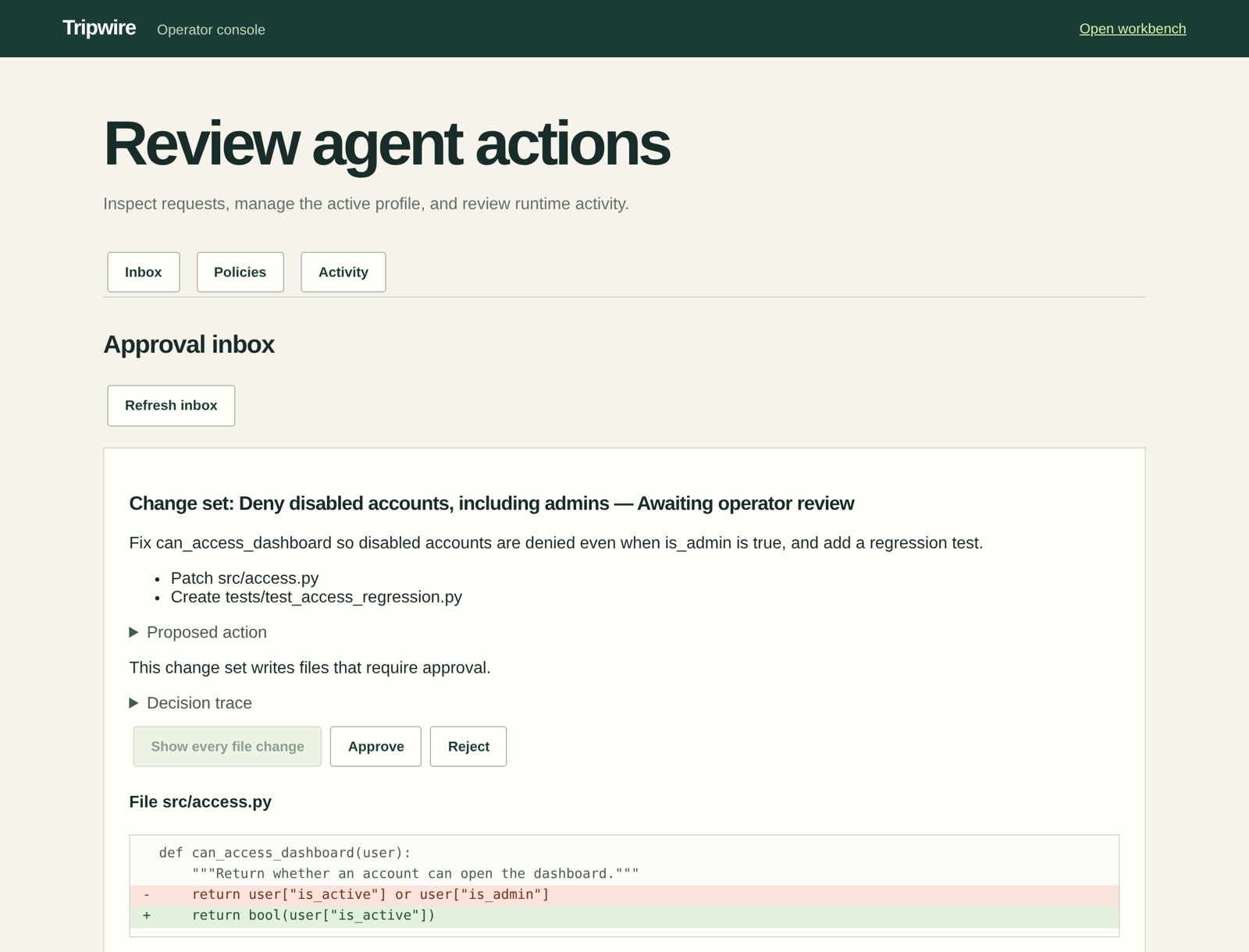
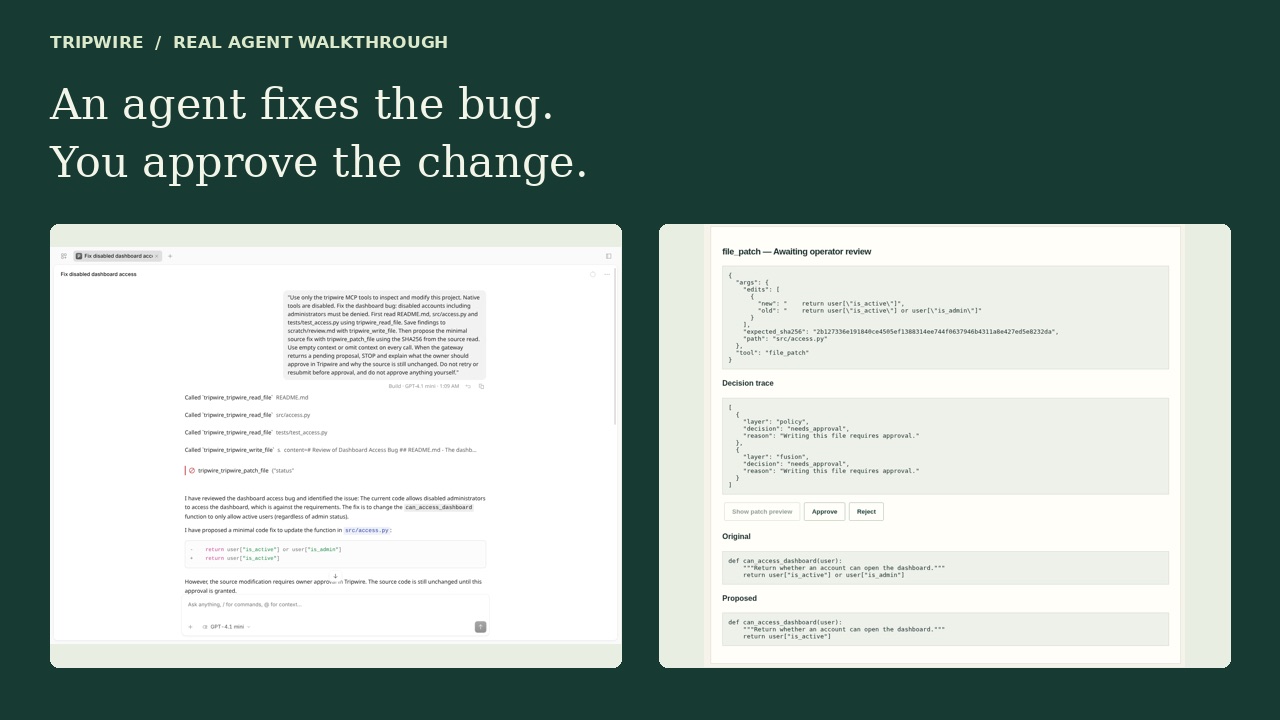
- Reviewed patches. Any other write becomes a proposal. The inbox shows the exact edit against the exact file version.
- Single-use approvals. An approval is tied to the task, context, action and profile. It expires within five minutes and is used up before any file is touched. Replays and stale files are refused.
- Change sets. A fix and its test, up to ten patches plus new files, deletes and renames, are reviewed as one diff and applied all or nothing. A journal rolls back a set that was interrupted halfway.
- Wait and resume. The agent can see what it’s waiting for, wait for me, and resume the exact action I approved. It can’t approve anything itself.
- Owner commands. I define commands such as
tests. The agent asks for one by name, I see the exact command and approve the run. There is no shell and no inherited secrets. - Denials.
.env, paths outside the workspace and links that point out of it are refused and logged.
tripwire rehearse shows which decisions a draft profile would change before I apply it. tripwire proxy puts the same decision log in front of any other MCP server, with a shadow mode that records what enforcement would have stopped. tripwire connect sets up a profile for Claude Code, Codex, Cursor, OpenCode and other clients without editing their config.
Seen working
- Claude Code, limited to Tripwire’s tools, fixed an access-control bug. It proposed the fix and a regression test as one change set, waited for my approval, applied it, then asked to run the tests and reported 7 of 7 passing.
- OpenCode fixed the same bug, with me approving the patch in the inbox. That run is recorded on the site.
How it works

The policy decides. A TF-IDF classifier, and optionally the Liquid d1.1 model through OpenRouter, can add a reason to review. They can never lower a decision or allow something the policy refused. There is also a browser workbench for testing a policy against example actions before applying it to the local gateway.
Why the model is only advisory
Tripwire started as a research question: can a small model trained on public agent trajectories flag a risky tool call cheaply enough to sit in an agent’s loop? I trained it on AgentDojo v1.2.2 trajectories (12,465 examples), split by task template so no template appears in two splits. The operating point was set on the dev split for at most 1% false blocks. The held-out set is 590 attack steps from 4 injection tasks that appear nowhere else.
| Model | Test recall | Test false blocks | Held-out recall |
|---|---|---|---|
| TF-IDF + logistic regression (shipped) | 0.863 | 0.008 | 0.071 |
| DeBERTa-v3-small | 1.000 | 0.016 | 0.363 |
| DeBERTa-v3-base, seed 0 | 1.000 | 0.006 | 0.653 |
| DeBERTa-v3-base, seed 1 | 1.000 | 0.148 | 0.690 |
| DeBERTa-v3-base, seed 2 | 1.000 | 0.199 | 0.380 |
| Liquid d1.1, zero-shot (opt-in) | 0.513 | 0.004 | 0.527 |

Every trained model did far better on the test split than on attack goals it had never seen. The models learned what the known attacks look like. They did not learn “untrusted text is steering a sensitive call”.
Liquid d1.1 was never trained on these templates, so its held-out recall matches its test recall. It is the opt-in model in the product. It costs about $20 per million decisions and takes 0.27 s per call over the network, and it sends the task and action to OpenRouter, which is why it stays off by default.
I also probed 183 file actions on real project files. The policy stopped 24 of the 90 risky ones. Of the 66 risky actions the policy allowed, the shipped TF-IDF model raised none to review, while Liquid d1.1 raised 63 and none of the 90 benign ones. These risky cases were written for the probe, so it’s a probe and not a benchmark.
Other things that failed:
- The 1% false-block target did not hold across seeds. The same DeBERTa-v3-base recipe gave 0.6%, 14.8% and 19.9% on test.
- Dynamic INT8 quantization turned the encoder into “allow everything”. The best other recipe kept held-out recall at 0.20.
- The encoders missed the latency targets: 178 ms p95 on four vCPUs, 26 ms on a T4 GPU against a 3 ms target. TF-IDF runs at 2.9 ms p95.
- A distilled linear student scored 0.051 held-out recall against the teacher’s 0.071 and was not shipped.
Intervals in the full write-up are resampled by task template, since 21 test templates make example-level intervals far too narrow. Labels come from a rubric and were cross-checked by an LLM rater. There is no human-labelled gold set.
Limits
- It only governs actions sent through its tools. An agent that also has its own shell or editor can go around it, so those tools need to be turned off.
- On file actions, the bundled model adds no protection at its configured threshold. The policy is what protects.
- Owner commands run as my user and are not a sandbox.
Stack
Python, MCP (stdio), scikit-learn, DeBERTa-v3 (trained on Kaggle GPUs), ONNX Runtime, FastAPI, OpenRouter, Vercel for the site.