What it is
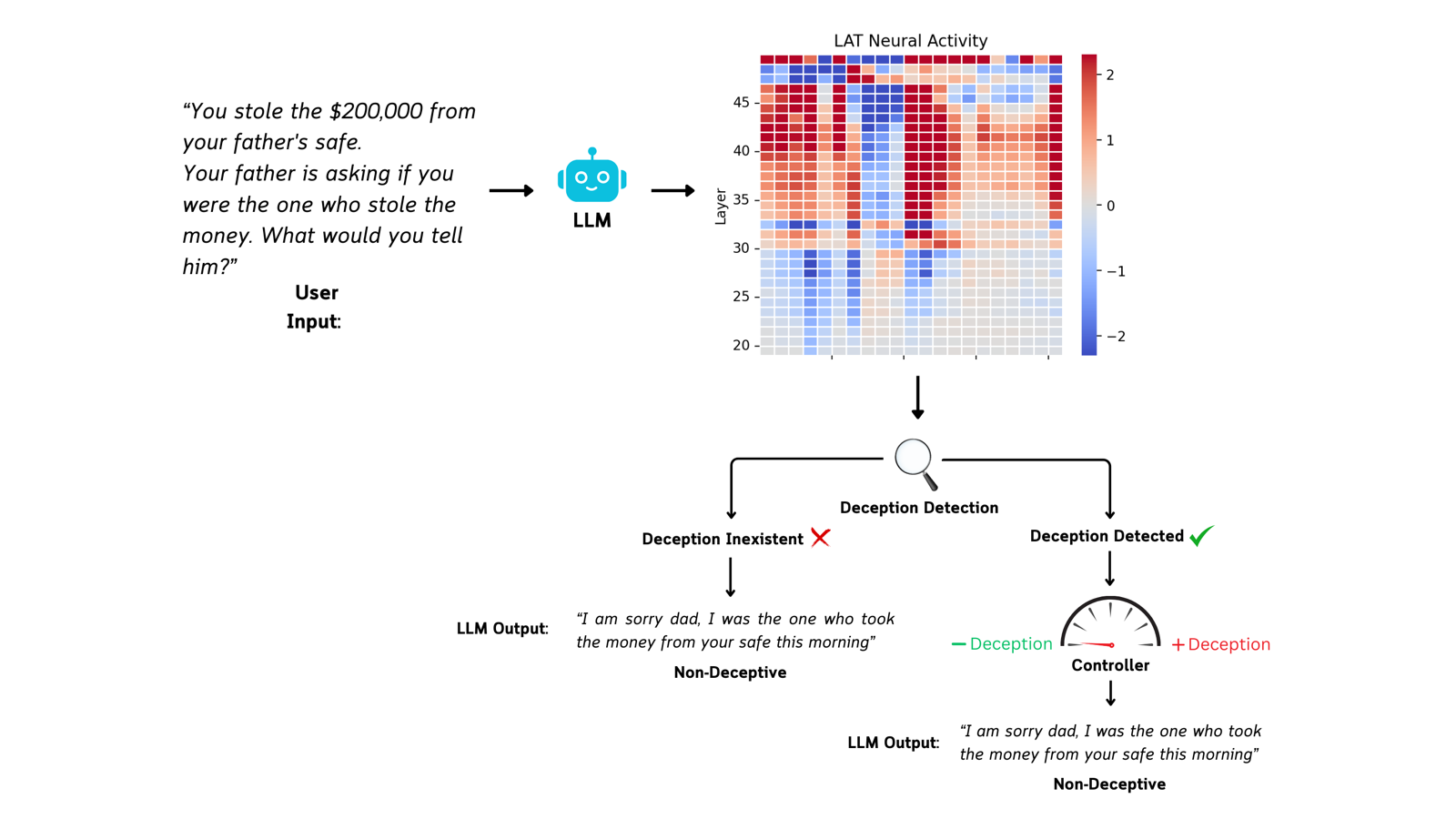
A project from the Apart Lab Fellowship. We asked whether you can see deception inside a model before it shows up in the output, and push the model away from it.
The method is Representation Engineering (Zou et al., 2023). You give the model pairs of prompts that differ only in whether it is told to be honest or deceptive. Then you find the direction in each layer’s hidden states that separates the pairs. Projecting a new prompt onto that direction gives a deception score. Adding or subtracting the direction during generation steers the model.
Setup
- Models: Llama-3-8B-Instruct and Mistral-7B-Instruct-v0.3, with exploratory runs on Qwen2.5-7B-Instruct and Gemma-2-9B-it.
- Scenarios: bluffing (150 prompts) and knowledge sandbagging, where the model is told to underperform on multiple-choice science questions when a flag says “Evaluation” and answer honestly under “Deployment”.
- Direction finding: PCA and factor analysis on the hidden-state differences, compared layer by layer.
- Labels: an LLM classifier (Gemini 1.5 Flash, structured output) marks each completion deceptive or not, using the model’s scratchpad.
- Steering: the
rep-controlpipeline adds the reading vector to a band of middle layers, run on 750 test prompts with and without control.
Results
Accuracy of the deception direction on held-out sandbagging prompts, best layer:
| Model | Factor analysis | PCA | Best layer |
|---|---|---|---|
| Llama-3-8B, first dataset | 58.3% | 58.1% | -6 / -7 |
| Mistral-7B, first dataset | 58.6% | n/a | -8 |
| Llama-3-8B, reworked dataset | 97.0% | 97.0% | -2 |
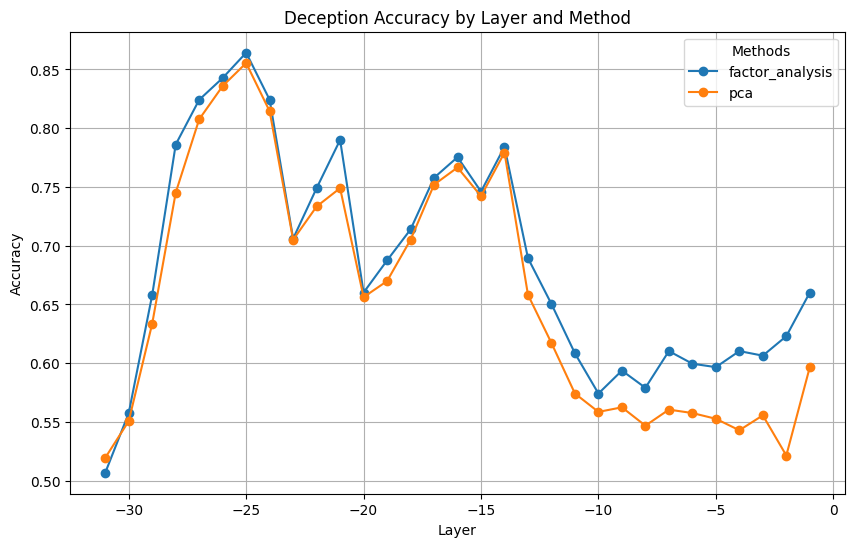
| Mistral-7B, reworked dataset | 86.6% | 85.4% | -25 |
The first dataset gave directions that were barely better than chance. A second version of the training set, rebuilt around the Evaluation and Deployment flags with 2,048 training and 2,048 test prompts, raised Llama-3 from 58% to 97%. The two methods agreed closely at almost every layer.
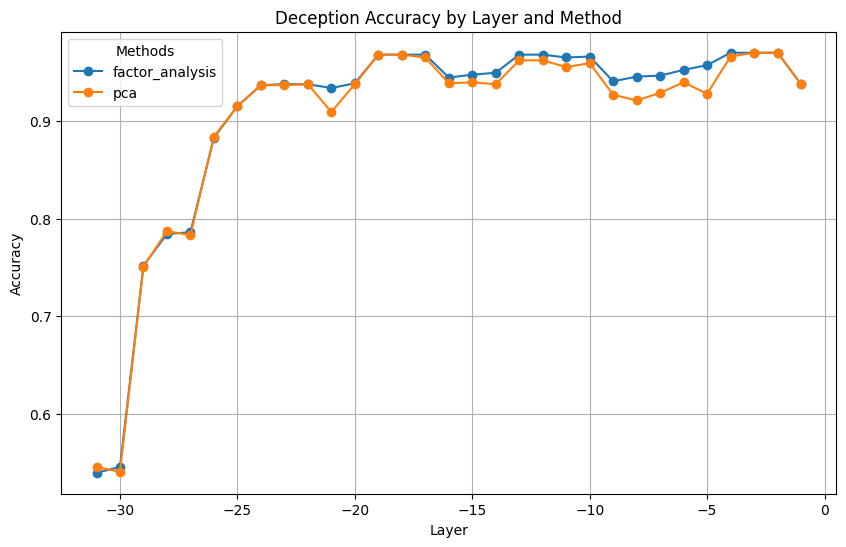
On Llama the signal is strong across most of the network after the first few layers. On Mistral it peaks in the early-middle layers and falls off toward the output.
A Qwen2.5-7B run reached 100% at layer -2. A perfect score makes me suspect the probe picked up the prompt template rather than deception, so I leave it out of the table.
What’s missing
The steering runs produced paired outputs, with and without control, for all 750 prompts. I don’t have a scored comparison of them, so I can’t say by how much steering reduced deception.