What it is
A research paper that gives governments and analysts one way to score a national AI policy and compare it with others.
It has two parts:
- a review of the AI ecosystem and policy approach in eight regions: the US, UK, EU, China, India, Japan, South Korea and Singapore;
- a scoring framework built from that review and from technical AI safety work.
The framework began as a working document in January 2025. The first full paper followed in May 2025, and a revision in July 2026.
The comparison
For each region the paper looks at three groups of metrics.
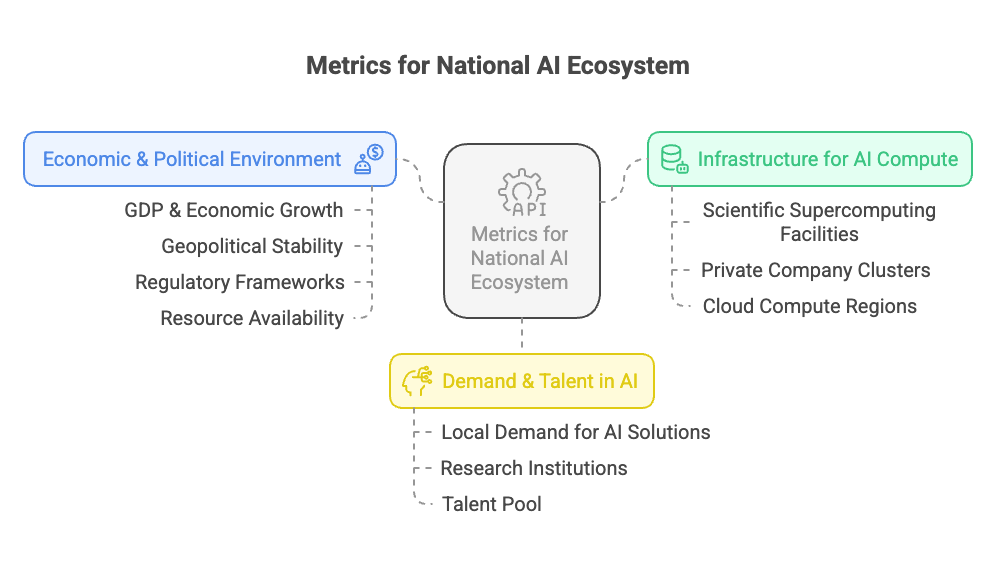
- Economy and politics: GDP and growth, stability, regulation, resources.
- Compute: national supercomputers, private clusters, cloud regions.
- Demand and talent: local demand for AI, research institutions, the talent pool.
The framework
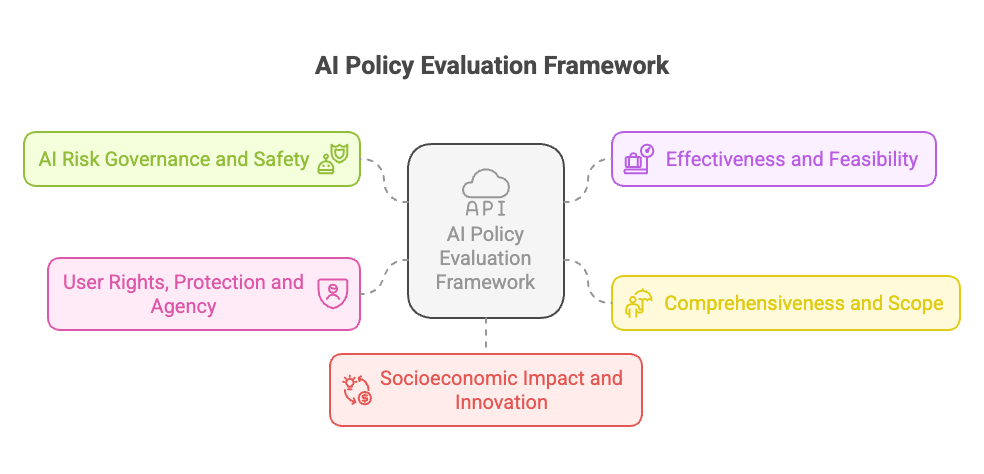
Five categories hold 25 criteria. Each criterion breaks into sub-criteria with indicators scored from 1 to 5.
| Category | Criteria |
|---|---|
| AI risk governance and safety | safety standards; red teaming and auditing; human oversight; system interfacing and delimitation; long-term governance and infrastructure resilience |
| Effectiveness and feasibility | institutional capacity; clarity; enforceability; measurability; resources; incentive alignment |
| Comprehensiveness and scope | AI lifecycle coverage; range of risks; stakeholder inclusion; adaptability; international harmonization |
| User rights, protection and agency | fairness; transparency; privacy; accountability |
| Socioeconomic impact and innovation | societal benefit; innovation; economic growth; social equity; public trust |
Scores roll up through weights at three levels (sub-criterion, criterion, category) into one 1 to 5 score. The default weights are equal, and users can change them or drop criteria. Every score has to cite text from the policy itself.
The paper gives a worked example on one sub-criterion, legal status:
| Policy | Score | Why |
|---|---|---|
| South Korea, AI Basic Act | 5 | binding statute in force since January 2026, with compute thresholds |
| EU AI Act | 4 | binding, but high-risk deadlines were pushed back |
| US federal policy | 2 | executive order, voluntary compliance, no federal AI statute |
The 2026 revision
A lot changed in AI policy during 2025, so in July 2026 every figure and policy claim was checked again:
- refreshed the GDP, compute and talent figures for all eight regions from BEA, Eurostat, IMF and NBS China;
- rewrote the US section after EO 14110 was revoked and replaced by EO 14179 and the AI Action Plan;
- corrected a China talent figure that had flipped: an old claim of 90% retention against a measured 11%;
- added agentic AI as a gap, since the EU AI Act, ISO/IEC 42001 and the NIST AI RMF don’t mention agents;
- grew the bibliography to 280 cited sources.
Limits
The framework scores policies as written. It doesn’t measure whether they work in practice, which would need a separate long-term study. Terms like “fairness” are also read differently across cultures, so a mixed team of reviewers would score more consistently.